
How to Build a Business Case for an Early Talent Program in 2026?
The workforce landscape in 2026 demands proactive talent strategies. Organizations facing leadership shortages, rapid digital transformation, and rising turnover must invest in structured development pathways.
Building a compelling case for an early talent program is no longer optional. For professionals leading these initiatives, LDP Connect offer research and peer insights that strengthen strategic decision making.
Organizations are navigating demographic transitions, accelerated innovation cycles, and increasing competition for skilled graduates. An early talent development program creates structured pathways that transform entry level hires into long term contributors and future leaders aligned with business priorities.
A significant portion of experienced leaders are approaching retirement, creating succession gaps across industries. Without a deliberate early talent development program, organizations risk leadership voids that disrupt continuity, knowledge transfer, and long-term performance stability.
Emerging technologies such as artificial intelligence, automation, and advanced analytics require specialized skills. An Early Talent Program helps cultivate digital fluency early, ensuring that new hires receive structured exposure to technical competencies aligned with future business demands.
Early career employees often change jobs within their first two years. A well designed early talent development program increases engagement, clarifies career pathways, and improves retention rates, reducing the high costs associated with repeated recruitment cycles.
A successful business case must clearly demonstrate alignment between the Early Talent Program and corporate strategy. Executives expect evidence that talent investments directly support revenue growth, operational efficiency, and long-term competitiveness.
Structured development accelerates time to productivity and encourages innovation. By rotating early career hires across functions, organizations create versatile contributors who identify efficiencies, generate ideas, and contribute measurable value within shorter timeframes.
An early talent development program strengthens diversity pipelines by expanding access to underrepresented talent. Structured mentoring and equitable development pathways improve representation in leadership roles and support measurable inclusion objectives tied to business performance.
Strategic workforce planning requires predictable leadership pipelines. An Early Talent Program provides data driven forecasting of promotion readiness, helping organizations mitigate risks related to sudden departures or unexpected succession challenges.
In 2026, leadership teams expect data driven proposals supported by financial modeling and measurable outcomes. A persuasive business case for an Early Talent Program must combine quantitative projections with strategic rationale.
Executives require clear financial projections that compare program investment with long term savings. ROI modeling should account for recruitment cost reduction, retention improvement, productivity acceleration, and decreased reliance on external senior hiring.
Benchmarking strengthens credibility. Referencing industry research and peer practices demonstrates that structured early talent development programs are standard among high performing organizations, reinforcing that the investment is both competitive and necessary.
Every investment carries risk. A strong proposal outlines potential implementation challenges, resource constraints, and mitigation plans, assuring leadership that the Early Talent Program will be managed with accountability and measurable oversight.
Measurement transforms a proposal from theory into a strategic asset. Clear success indicators ensure that the Early Talent Program demonstrates tangible value and earns sustained executive support.
Early metrics include onboarding effectiveness, training completion rates, engagement survey results, and supervisor feedback. These indicators show whether participants are integrating successfully and contributing to team performance.
Longitudinal tracking reveals promotion rates, leadership readiness, and succession coverage. Organizations that invest in structured early talent development programs often experience stronger internal mobility and reduced reliance on external leadership recruitment.
Regular evaluations, participant surveys, and manager assessments provide insights for refinement. Continuous improvement ensures that the Early Talent Program evolves alongside business needs and maintains relevance in changing market conditions.
Even well structured proposals may encounter resistance. Anticipating concerns strengthens your case and demonstrates strategic foresight when presenting an Early Talent Program to senior leadership.
Budget concerns often arise during uncertain economic periods. Present phased implementation models that spread investment over multiple fiscal years while still delivering measurable progress toward long term talent objectives.
Strong recruitment does not replace structured development. Hiring talented graduates without a defined growth framework often leads to disengagement, inconsistent performance, and higher turnover over time.
Executives want assurance that programs can scale across departments and regions. Outline standardized processes, governance models, and evaluation systems that ensure long term sustainability and measurable accountability.
Professionals building or managing an early talent development program benefit from shared insights and proven tools. LDP Connect is the community of professionals who lead, manage or support early career talent development programs.
With an active membership of over 800, the community has served members with research, tools, and events since 2012. Through original research, meetings, and best practice events, members gain practical guidance that strengthens program strategy and execution.
Organizations seeking evidence-based approaches to early talent development can benefit from joining this established professional community.
Crafting a strong proposal is only part of the process. Delivering the message strategically increases the likelihood of executive approval and long-term organizational commitment to the Early Talent Program.
An effective proposal begins with a concise executive summary outlining objectives, financial projections, risks, and measurable outcomes. Clear visuals, dashboards, and projections make complex information easier for leadership teams to evaluate.
Engage stakeholders from finance, operations, human resources, and department leadership early. Cross functional alignment strengthens credibility and ensures the Early Talent Program integrates seamlessly into broader organizational processes.
A multi year roadmap demonstrates strategic foresight. Outline pilot phases, expansion milestones, and evaluation checkpoints that show how the early talent development program will mature and deliver increasing value over time.
In 2026, organizations cannot rely solely on external hiring to meet evolving workforce demands. A structured Early Talent Program builds leadership pipelines, strengthens retention, and aligns workforce capabilities with strategic objectives.
By presenting clear financial modeling, measurable outcomes, and long term workforce impact, professionals can secure executive support for early talent development initiatives.
Thoughtful planning, benchmarking, and community driven insights position organizations to transform early career hires into future leaders.
An Early Talent Program is a structured development initiative designed to cultivate early career hires through training, mentorship, and rotational experiences. Unlike recruitment alone, it focuses on long term growth and leadership pipeline development.
ROI is calculated by comparing program costs with measurable benefits such as improved retention, reduced recruitment expenses, faster productivity, and decreased reliance on external leadership hiring.
Key metrics include retention rates, promotion velocity, time to productivity, engagement scores, and succession readiness indicators. These metrics demonstrate tangible business impact tied to organizational goals.
Short term engagement and productivity improvements may appear within the first year. Leadership pipeline outcomes and promotion impacts typically become measurable within two to three years.
Common mistakes include failing to align with corporate strategy, lacking financial modeling, ignoring measurable outcomes, underestimating resource requirements, and presenting the proposal without cross functional support.
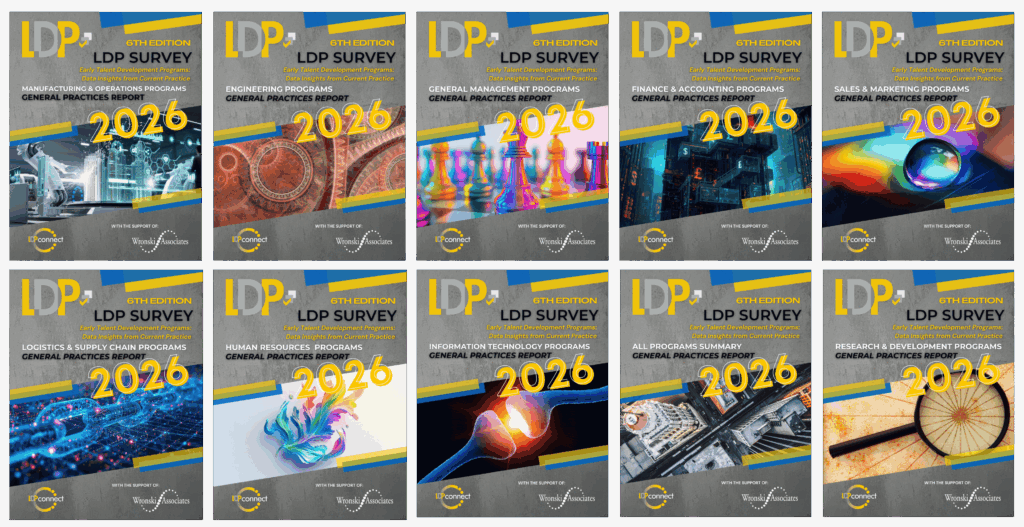
Rention rates, NPS scores, Diversity metrics
Curiculum elements, Program structure & more!
From 177 early talent development programs
Across 94 organizations and 9 functional areas

New applications are typically reviewed within an hour of submission. You'll receive an email notification shortly.