
One of the biggest misconceptions about early talent programs is that they are simply a collection of onboarding activities, training sessions, and rotations. While each of these components is important, they’re only effective when they’re intentionally designed to work together.
A strong early talent program isn’t defined by the individual activities it offers. It’s defined by the structure that connects those experiences into a cohesive development journey. Every interaction, learning opportunity, and milestone should build upon the last, helping participants grow from early career professionals into confident contributors and future leaders.
Whether your organization manages a single internship program, multiple functional leadership development programs, or an enterprise-wide early talent strategy, thoughtful program architecture creates consistency for participants while giving program leaders a scalable framework they can benchmark, evaluate, and continuously improve.
In this guide, we’ll explore the core building blocks of an effective early talent program structure and how to intentionally design a participant experience that supports both individual growth and long-term business success.
A well-designed early talent program is more than a collection of training sessions. It is the blueprint that connects every stage of the participant experience, from onboarding and formal learning to stretch assignments, mentoring, and career progression.
Without an intentional structure, development can become inconsistent. Participants may receive different experiences depending on their manager, opportunities may arise by chance rather than design, and organizations may struggle to measure whether the program is delivering meaningful outcomes.
Thoughtful program architecture creates consistency while still allowing flexibility. It helps participants understand where they are in their development journey, gives managers a shared framework for coaching, and enables program leaders to evaluate, benchmark, and improve the program over time.
A well-structured early talent program should:
Every organization approaches early talent development differently. Some manage a portfolio of functional leadership development programs, while others focus on internships, rotational programs, or a single enterprise-wide initiative. Although the structure may vary, the strongest programs share one characteristic: every experience is intentionally designed to build upon the last.
The following framework outlines the essential building blocks that help participants gain knowledge, apply new skills, expand their perspective, and prepare for increasing responsibility throughout the program.
The structure of any early talent program should be based upon a clear definition of success. Before designing learning experiences, selecting rotations, or assigning mentors, program leaders should establish what participants are expected to know, experience, and demonstrate by the end of the program. These objectives become the foundation for every design decision that follows.
Effective objectives balance participant development with organizational needs. The structure of the program should reflect long-term workforce priorities rather than applying a one-size-fits-all approach.
Clearly defined objectives also make it easier to align curriculum, experiential learning, assessments, and success metrics. When every component of the program supports the same outcomes, participants receive a more cohesive and purposeful development experience.
Exceptional early talent programs intentionally sequence experiences so each one builds upon the last. Participants should gradually move from learning foundational concepts to applying those skills in increasingly complex situations.
Rather than overwhelming participants during onboarding, consider organizing the program into distinct phases with clear developmental milestones. Early stages may focus on orientation and technical learning, while later phases introduce cross-functional experiences, strategic projects, executive exposure, and increasing levels of ownership.
Thoughtful sequencing helps participants build confidence while giving program leaders a framework for evaluating progress throughout the journey.
Onboarding should do more than introduce policies, tools, and company procedures. In a well-structured early talent program, onboarding is the first intentional phase of the participant journey. It sets expectations, builds connections, and helps participants understand how the program will support their development over time.
For cohort-based programs, onboarding also creates an important opportunity to build peer relationships early. Participants who feel connected to their cohorts, managers, mentors, and program leaders are more likely to feel supported as they navigate the transition into the organization.
When designed intentionally, a strong onboarding phase gives early talent the confidence, context, and relationships they need to begin contributing while understanding how each stage of the program connects to their long-term growth.
One of the most common mistakes organizations make is front-loading too much learning during orientation or the first few weeks of the program. Participants often retain mor when learning is delivered at the moment it’s needed. Spacing learning throughout the program allows participants to immediately apply new knowledge when it’s relevant, reinforcing concepts through experience instead of information overload.
A progressive curriculum should balance formal instruction with opportunities to practice new skills. Depending on the goals of your program, this may include:
As participants progress through the program, the curriculum should evolve alongside them. This intentional progression helps participants build capability over time rather than expecting mastery from the outset.
Formal training provides the foundation, but meaningful workplace experiences are where participants begin to build confidence and professional capability. But exceptional early talent programs don’t just expose participants to work—they expose them to the right level of challenge at the right time. The role of thoughtful program architecture is to gradually increase complexity as participants build competence and confidence.
Early program experiences might focus on observation and guided practice, while increasingly complex responsibilities are added as participants move through the program, challenging them to apply what they’ve learned while contributing meaningful value to the organization.
These experiences might include:
Rather than assigning repetitive administrative work, create opportunities for participants to solve real business challenges, contribute to meaningful initiatives, and experience increasing levels of ownership throughout the program.
By progressively increasing responsibility and exposure over time, organizations help participants develop the confidence, business acumen, and practical skills needed for long-term success.
One of the greatest advantages of an early talent program is the opportunity to help participants see beyond their individual role. While this is common within rotational programs, it can still be incorporated into enterprise-wide initiatives to help participants understand how different parts of an organization work together to achieve shared goals.
Cross-functional experiences develop a broader perspective by exposing early talent to the people, processes, and decisions that drive the organization. Developing a systems-level understanding strengthens collaboration, improves decision-making, and prepares participants to think beyond functional silos as their careers progress.
Cross-functional learning can take many forms, including:
When designed intentionally, cross-functional experiences help participants to build relationships across the organization, strengthen enterprise thinking, and develop the strategic perspective needed for future leadership roles.
No participant should navigate an early talent program alone. While structured learning and meaningful experiences provide the foundation for development, strong support networks help participants build confidence, overcome challenges, and make the most of every stage of the program.
The strongest programs intentionally build a network of support that provides different perspectives and contributes to a well-rounded development experience. A strong support network may include:
Development is not an individual activity. It happens through shared experiences, meaningful relationships, and ongoing guidance from the people around us. Regular check-ins, scheduled mentoring conversations, peer networking opportunities, and alumni engagement help ensure participants receive consistent support throughout the program instead of only when challenges arise.
Feedback should be intentionally build into every stage of an early talent program. Rather than relying on a single evaluation, design structured feedback checkpoints at key milestones throughout the program. Regular feedback helps participants understand their progress, build confidence, and make meaningful adjustments as they continue developing throughout the program.
Equally important is creating opportunities for participants to reflect on their own experiences and provide feedback on the program itself. Self-assessments encourage participants to take ownership of their development, while participant feedback helps program leaders understand which learning experiences are the most effective, where additional support may be needed, and how the program can continue to evolve over time.
Exceptional programs structure feedback as an ongoing system that benefits participants, managers, program leaders, and future cohorts. Intentionally structuring feedback loops into your program creates a learning system that becomes stronger, more responsive, and more effective over time.
A thoughtfully designed early talent program should include an equally thoughtful measurement strategy. Effective measurement goes beyond tracking participation or completion rates. It should evaluate both participant development and program effectiveness, helping organizations understand how cohorts are progressing and how well the program supports broader business objectives.
Key performance indicators may include:
Participant Outcomes
Program outcomes
Looking at both participant and program outcomes provides a more complete picture of success. Trends over time can help program leaders identify strengths, uncover opportunities for improvement, and demonstrate the long-term value of the program to key stakeholders.
The goal isn’t simply to collect data, but to understand whether the program architecture is producing the participant experiences and business outcomes it was intentionally designed to achieve.
While a well-designed program provides structure and consistency, it should also be flexible enough to evolve alongside changing business priorities, workforce expectations, and participant needs.
Rather than making changes only when something isn’t working, build regular program revies into your annual planning process. Evaluate the program architecture as a whole, not just individual learning activities, to ensure every component continues to support the participant journey and business objectives.
Continuous improvement should draw from multiple sources, including participant feedback, manager observations, program outcomes, changes in business priorities, and benchmarking. Looking at these insights collectively allows you to strengthen the program, address small issues before they become large ones, and reveal opportunities that may not be visible from within your own program.
The most successful programs are committed to continuous learning and development. By making intentional, data-informed improvements over time, program leaders can build a program that remains relevant, resilient, and impactful for every new cohort.
From onboarding and progressive learning to experiential development, support networks, and continuous feedback, every element of an early career program should work together to create a cohesive participant journey that supports both individual growth and organizational success.
A thoughtful program structure helps organizations deliver consistent, meaningful development experiencing while remaining flexible enough to adapt as business needs evolve. Whether you’re designing a new program or strengthening an existing portfolio, the most successful programs lay down a sturdy framework that makes room for growth and change.
Exploring how other organizations approach program design, participant development, and benchmarking can provide valuable insights as you refine your own program structure. To learn more, explore LDP Connect – the community of early talent development professionals.
1. What is an early talent program structure?
An early talent program structure is the intentional framework that organizes a participant’s development journey. It defines how onboarding, learning experiences, workplace application, feedback, mentoring, and career development are sequenced to support both participant growth and organizational objectives
2. Why is a structured program important?
A thoughtful program structure creates consistency across the participant experience while ensuring every stage of development builds toward clear learning and business outcomes. It also provides program leaders with a scalable framework for measuring success, benchmarking performance, and continuously improving the program over time.
3. What should an early talent curriculum include?
While every organization designs its programs differently, most successful programs combine structured onboarding, progressive learning, experiential development, cross-functional exposure, meaningful support networks, regular feedback, and measurable milestones that guide participant growth throughout the program.
4. How can organizations measure program success?
The most effective measurement strategies evaluate both participant progress and overall program outcomes. Common metrics include participant engagement, milestone completion, retention, internal mobility, leadership readiness, manager feedback, and program completion. Together, these measures provide insight into both participant development and program effectiveness.
5. How often should an early talent program be reviewed?
Early talent programs should be evaluated continuously through participant and manager feedback, with formal program reviews conducted after each cohort or major program cycle. Regular evaluation helps organizations adapt to changing business priorities, incorporate participant insights, and refine the program architecture over time.
Rention rates, NPS scores, Diversity metrics
Curiculum elements, Program structure & more!
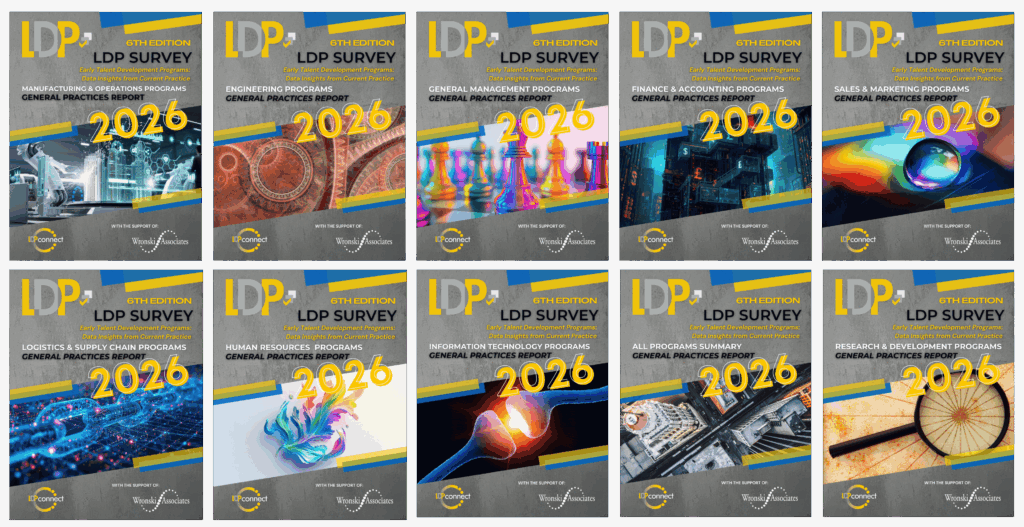
From 177 early talent development programs
Across 94 organizations and 9 functional areas

New applications are typically reviewed within an hour of submission. You'll receive an email notification shortly.